Re-use the fallen Church

Project idea

Is it possible to bring back to life one of the most important religious buildings of Southern Italy? We tride to answer this quastion in our architectural project that was choosen for our project of the year in our university. Chiesa Diruta is a catholic church built in Grottole in the 15th century, in order to host the local community of clergymen and to become one the most important churches of the bishopric. It suffered a lot of damages due to earthquakes, fires, and building issues so it was soon abandoned. The main aim was to reuse this space of this abandoned Church as a Concert Hall.

Project description

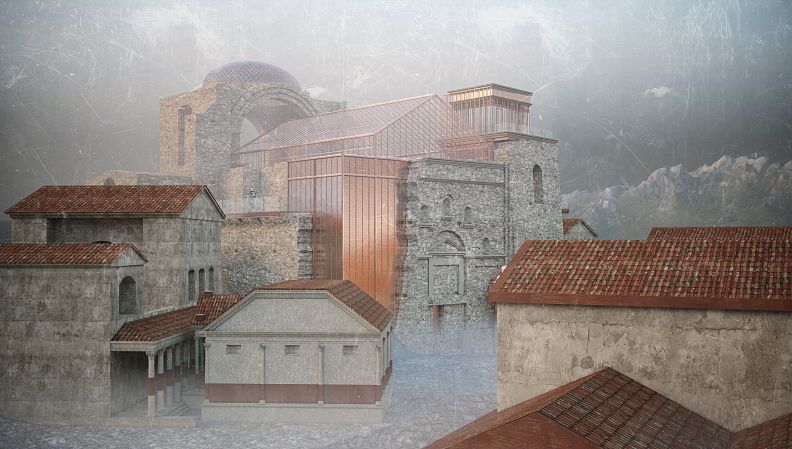
In our project we tried to carefully regenerate architectural structure of the church, as well as reorganize an interior space by choosing not a traditional way of preparing design. This project was created with the intent to preserve the link between architecture and nature throughout the time. The idea consists of regenerating the space and preserving the spirit of the place of the Italian town. We chose the method of devizualization of the new architecture, using translucent and reflective planars. They complete the look of the church, by standing in the background and giving all the attention to the authentic church. Thus, the new construction become a "ghost building" because of using glass to create the effect of dissolving into space, and filling the pause in the context of the urban space. Applying the Gestalt philosophy of "no presence "or" presence of absence", we preserve the impact of nature on the building, not only by the "ghost" forms, but also by not removing plants from the facades, to continue this theme of the thematic incorporation of the architecture and nature. All the main ruined parts - the roof, the walls, vaults, and arches became visible again but now only in the glass and copper to show the contrast of old and new but in the same time to save the essence of “genius loci”. In our project, we decided to regenerate the dilapidated tower, and because of that we could make view platforms outside the walls of the church on both sides. In addition to that the common space of the apse will become a great viewpoint to watch sunsets. All in all our project of regeneration of the fallen church is based on the method of devizualization of the new structures and on the thematic incorporation of the architecture and nature to save the essence of “genius loci”.

Technical information

The main feature of the redevelopment was a radical change in the orientation of functional spaces. For a long period of time we had been thinking about how to accommodate everything in the most convenient way and finally went from the method "how it cannot be". In this version, the main entrance is organized from the apse, and the narthex is given to the artists ' rooms. Café is situated on the ground floor. In addition to the main hall, there is also a small lecture hall on the first floor. Copper became the main material in this project, as well as glass. The existence abundance of greenery shows that nature always prevails over the people creations, but at the same time it forms the dynamic of the space and give us a sense of calm.

Alena Kokueva, Silviya Al Ubed

Yaroslavl State Technical University

Russian Federation

Architektura

Projekt odovzdaný

14. 07. 2021

Tag

Architektura Religious

Rada studentům

Réutiliser l'église déchue

Chère Alena, j'ai lu votre commentaire avec beaucoup d'attention et j'ai découvert avec plaisir votre projet, qui est très inspirant dès le départ. Il incite à la réflexion et à l'envie de parfaire un travail déjà bien abouti. C'est pourquoi je vous livre ce petit compte-rendu de mes impressions, en espérant qu'il vous sera utile. La question est de faire revivre l'espace et non la fonction de ce bâtiment, ne peut-il y avoir confusion ? La dimension du sacré peut-elle subsister et prendre un autre aspect malgré la disparition de la pratique religieuse qui lui est liée ? Je pense que le choix de la salle de concert est judicieux dans ce cas, à condition que l'espace et l'atmosphère qu'elle supporte soient adéquats. Le choix de la " devisualisation " me semble vouloir répondre à cela, en gardant l'intervention en arrière plan de l'existant, essayant ainsi de garder la Trace (mystique ?) du bâtiment d'origine. Mais là, je pense que beaucoup y verraient trop d'effacement de votre part. Votre projet est lié à un thème que j'ai abordé avec des étudiants dans des projets de fin d'études et qui est celui de l'actualisation du patrimoine par l'architecture contemporaine. C'est une solution à la polarité conservation-création que nous avons découverte grâce au travail d'Alexandra Georgescu Paquin (j'ai mis la référence en français, j'espère que vous trouverez du matériel dans la langue de vos études : https://www.puq.ca/catalogue/livres/actualiser-patrimoine-par-architecture-contemporaine-2778.html). Les exemples étudiés pour ce phénomène me font penser à votre projet : Le centre CaixaForum de Barcelone (Arata Isozaki), le Centre national d'art Reina Sofía de Madrid (Jean Nouvel), le musée du théâtre romain de Carthagène (Rafael Moneo). L'expression de votre idée structurante ne souffre d'aucune faiblesse théorique, cependant, je recommanderais de tempérer cette "approche par l'absence" dans la phase de projection. D'une manière générale, je recommande à mes étudiants de revenir itérativement à l'utilisateur, à " sa " présence, à son évolution dans l'espace que l'on met en place pour lui. Même si l'enthousiasme du projet nous pousse à explorer les voies théoriques et les constructions d'idées complexes, il faut à un moment donné revenir à la dimension humaine en prenant en charge la " réception " de l'information : comment l'utilisateur va-t-il s'adapter à l'espace ? A-t-on géré l'échelle du projet ? Pour cela, je recommande habituellement de s'attarder sur les coupes ; elles représentent - à mon avis - le meilleur indicateur de la complexité et de la réussite du projet. Or, la seule coupe que vous proposez ne permet pas une lecture distincte des ambiances. Autre indicateur qui peut vous paraître anodin mais dont je considère la dimension informative (puisque c'est ma spécialité !), c'est le traitement de vos vues avec un ciel dans les mêmes tons que le bâtiment et qui tend à brouiller la lecture. . Comme s'il ne fallait pas distinguer le bâtiment d'origine de votre intervention et de l'environnement général. Doit-on distinguer une sorte de galerie à l'étage ? donnant sur la salle de concert ? Si oui, une sorte de triforium (je donne là une référence anachronique !), C'est trop peu affirmé à cause de l'excès de transparence. Pouvez-vous essayer de remplacer les garde-corps en verre par des plaques de cuivre et voir si cela n'écrase pas la vue tout en donnant plus de "présence" à votre geste architectural. Parce que vous avez un geste, une touche personnelle, c'est très intéressant et il serait dommage de ne pas le dire plus.
20.03.2026

Nabil ROUBAI CHORFI

Kategorie

Copyright © 2026 INSPIRELI | All rights reserved. Use of this website signifies your agreement to the Terms of Use, Privacy Policy, and use of cookies.